DeepSeek dsh-superagent Goes Open Source: Router-Worker Architecture Autonomously Monitors GitHub, p95 Task Completion in Just 15.7 Minutes
On October 31, 2026, DeepSeek's Harness team officially released dsh-superagent v0.1.0, an open-source coding agent under the MIT license, directly challenging Anthropic's Claude Code. Built around an innovative "Router-Worker" dual-layer architecture, this tool proactively monitors GitHub repositories and Feishu group chats, autonomously identifying issues and proposing solutions without requiring explicit user prompts.
What is dsh-superagent?
dsh-superagent is an autonomous coding agent that fundamentally differs from traditional AI assistants that wait for user commands. It operates on a proactive design philosophy: continuously monitoring the development environment, identifying problems independently, and executing fixes when authorized.
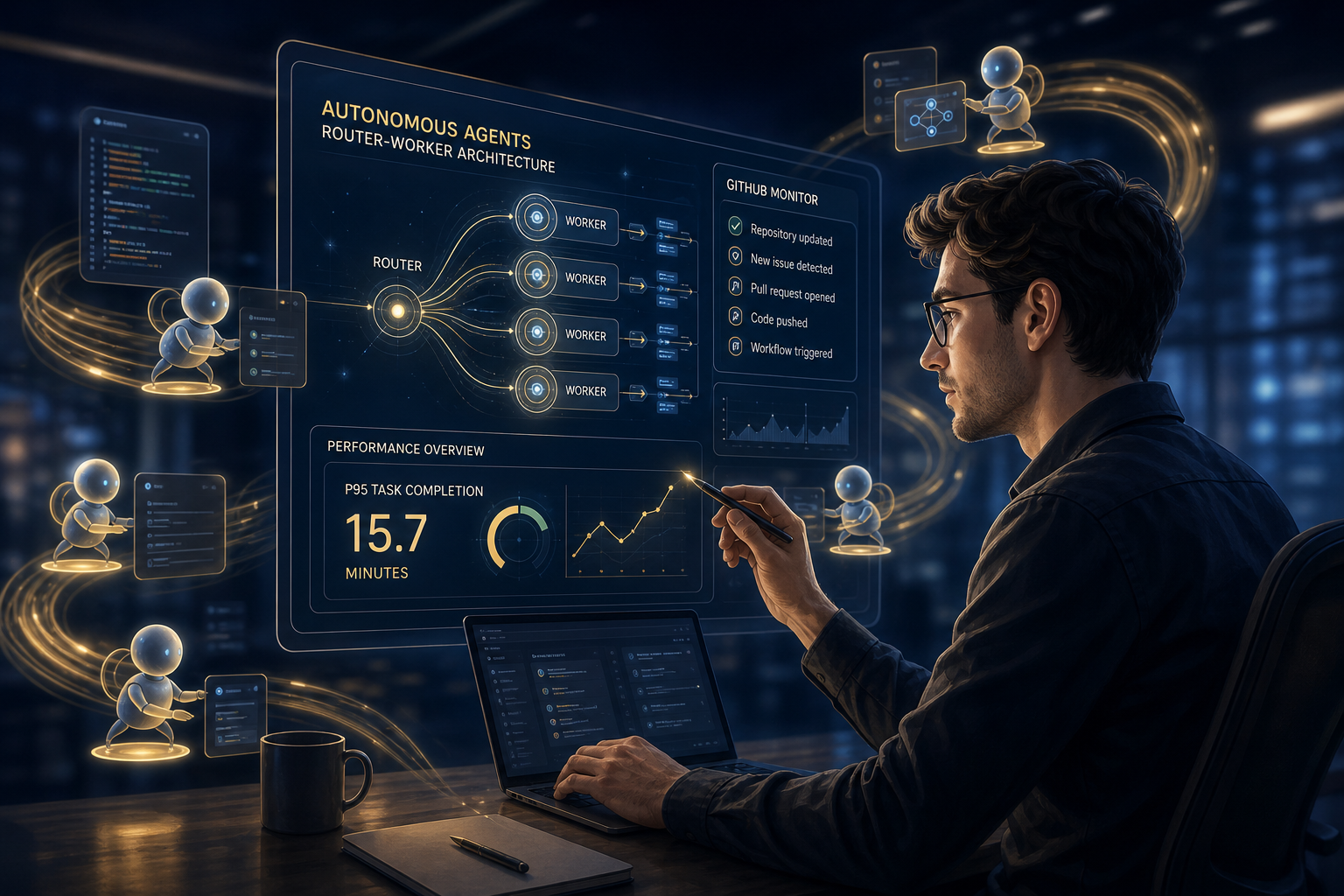
According to DeepSeek's official documentation and technical analysis from MarkTechPost, the tool's core architecture consists of two layers:
The Router Layer
The Router is a persistent process responsible for:
- Managing all incoming trigger events (GitHub events, Feishu messages, etc.)
- Evaluating event priority and allocating work
- Dispatching tasks to appropriate Worker sessions
- Maintaining overall system state
The Worker Layer
Each Worker is an isolated, task-specific execution environment:
- Each "Ticket" (unit of work) is assigned its own dedicated Worker session
- Workers subscribe directly to relevant threads (e.g., pull requests or chat topics)
- Subsequent events are handled without Router intervention
- Resources are automatically released upon task completion
Core Performance Metrics
DeepSeek's internal simulations demonstrate significant advantages of the Router-Worker architecture over traditional single-session agents:
| Metric | dsh-superagent | Single-Session Baseline | Improvement |
|---|---|---|---|
| p95 Task Completion Time | 15.7 minutes | 29.5 minutes | 47% faster |
| High-Load Stability | Stable (1-40 events/min) | Linear degradation | Significant |
| Task Batching | Supported | Not supported | New capability |
In stress tests where trigger event arrival rates increased from 1 to 40 events per minute, the system successfully batched tasks while maintaining stable request latency, demonstrating excellent horizontal scalability.
Three Authorization Modes
To prevent unintended autonomous behavior, dsh-superagent offers three configurable authorization modes:
- Off: The agent does not consider any inferred tasks as candidates — fully passive
- Observe (Default): The agent records tasks it would have performed but does not execute them — ideal for initial evaluation
- Auto: The agent automatically executes tasks upon positive assessment — suitable for high-trust production environments
This graduated authorization design allows development teams to progressively increase autonomy after fully understanding agent behavior, effectively managing risk.
Technical Requirements and Deployment
dsh-superagent is not a hosted service but a self-hosted TypeScript bundle:
System Requirements:
- Node.js v22.19+ or v24+
- Git 2.32+
- Python 3.8+
- tmux
- GitHub CLI
Deployment: Installed as a profile within the DeepSeek Harness runtime
Security Note: Since the agent has access to local files and system commands, official documentation recommends running it in a dedicated OS account with restricted credentials to mitigate risks associated with "danger-full-access" permissions.
Competitive Landscape vs. Claude Code
The release of dsh-superagent marks a new phase in the open-source AI coding agent market. Anthropic's Claude Code currently leads in enterprise AI coding assistance, while DeepSeek's MIT-licensed open-source approach directly lowers the barrier to enterprise adoption.
Key Differentiators:
- Proactivity: Monitors and proposes solutions without waiting for commands
- Open-source and free: MIT license with no usage fees
- Multi-platform integration: Supports both GitHub and Feishu (Feishu) ecosystems
- Configurable autonomy: Three authorization modes for different risk profiles
Asia-Pacific Perspective
For development teams across the Asia-Pacific region, dsh-superagent's Feishu integration carries special significance. Feishu, ByteDance's enterprise collaboration platform, has a substantial user base across mainland China, Southeast Asia, and Japan. The ability to directly monitor Feishu group chats and automatically respond to technical issues gives this tool a natural advantage in APAC enterprise environments.
Furthermore, as a product from Chinese AI company DeepSeek, dsh-superagent's open-source strategy reflects the growing openness of China's AI ecosystem — following the open-sourcing of models like DeepSeek-R1, tooling-level open-sourcing further lowers the barrier for global developers.
Current Limitations and Future Outlook
As a v0.1.0 research prototype, dsh-superagent currently has several limitations:
- Some features discussed in design essays are not yet implemented in the public code
- The team explicitly states it is not yet intended for production use
- Requires self-maintained infrastructure
The DeepSeek Harness team has indicated continuous iteration, with subsequent versions expected to enhance stability and expand the feature set.
Conclusion
dsh-superagent represents an important evolution in AI coding agents from "passive response" to "proactive collaboration." The Router-Worker architecture's p95 task completion time of 15.7 minutes — a 47% improvement over the single-session baseline of 29.5 minutes — demonstrates the enormous potential of parallel processing in agent systems. With open-source community participation, this tool is poised to mature rapidly in the coming months, becoming an important component of enterprise AI development workflows.