
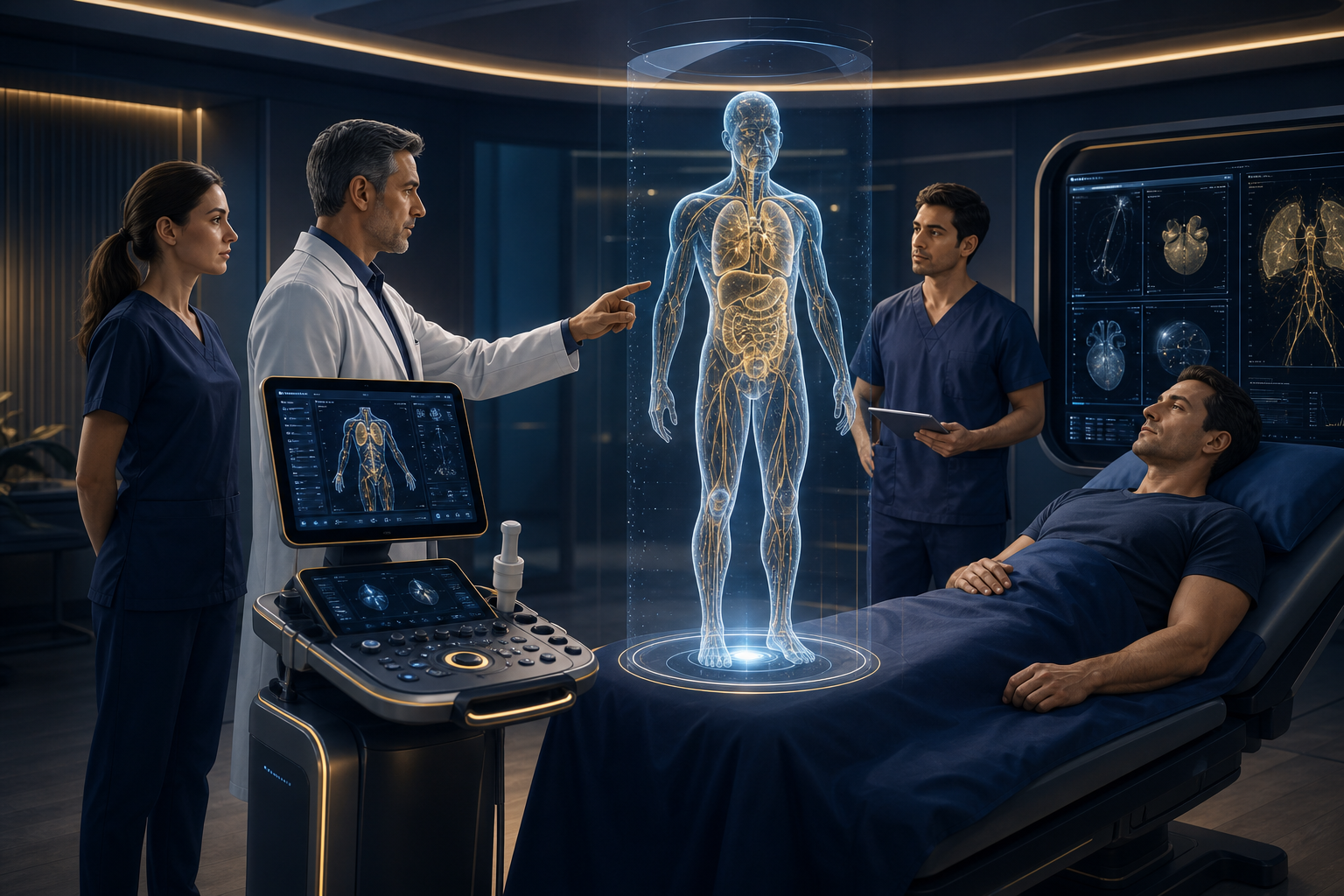
Midjourney Enters Healthcare: Full-Body Ultrasound Scanner Generates 3D Maps in 60 Seconds, A New Chapter in AI Health Revolution
Introduction
Midjourney, known for AI image generation, announced the establishment of a medical division "Midjourney Medical" in June 2026 and unveiled a revolutionary full-body ultrasound scanner prototype. This device can generate full-body 3D maps in approximately 60 seconds, marking an unprecedented way AI companies are entering the healthcare sector.
Technical Principles and Device Specifications
Scanning Technology
Midjourney's full-body scanner uses ultrasound technology (not X-rays or radiation), with the following working principle:
- Scanning Process: The user steps onto a platform that descends into a shallow pool of water
- Sensor Array: A ring of underwater sensors transmits ultrasonic waves through the body
- 3D Reconstruction: Reconstructs 3D cross-sectional images of organs, muscle, fat, and bone
- Scan Duration: Approximately 60 seconds total
Core Technology Partnership
Midjourney signed an exclusive licensing agreement with Butterfly Network (signed November 2025), using 40 "Ultrasound-on-Chip" modules per device. Butterfly Network's ultrasound chip technology is an industry-leading portable ultrasound solution, now extended to full-body scanning applications through this partnership.
Technical Positioning
Midjourney founder David Holz has positioned this device as potentially superior to MRI in certain respects, though these claims remain unverified by independent parties. As a first-generation prototype, the device continues to be refined.
Regulatory Status and Commercial Strategy
FDA Approval Pathway
Currently, the Midjourney scanner lacks FDA clearance for diagnostic purposes. Therefore, the company plans to launch the service by providing "body composition maps" rather than clinical diagnoses, circumventing strict medical device regulatory requirements.
Commercialization Pathway:
- Initial phase: Provide body composition analysis (muscle, fat, organ positions, etc.)
- Mid-term: Submit data to FDA to seek approval for broader diagnostic capabilities
- Long-term: Develop into a comprehensive preventive health screening tool
Medical Community's Cautious Stance
Medical experts have expressed caution about this device, with key concerns including:
- Incidental Findings: Scans may discover abnormalities patients are unaware of, causing unnecessary anxiety
- Clinical Context: Image interpretation without clinical context may lead to misdiagnosis
- Over-medicalization: Large-scale screening of healthy populations may lead to unnecessary follow-up examinations
Midjourney Spa: A New Healthcare Business Model
Flagship Experience Center
Midjourney plans to open a "Midjourney Spa" in San Francisco's Union Square by late 2027, integrating scanning experiences with wellness services:
- Gym facilities
- Sauna services
- Full-body scanning
- Personalized health recommendations
Global Expansion Plans
The company has set an ambitious long-term goal: deploying approximately 50,000 scanners worldwide by 2031. If achieved, this would make Midjourney one of the world's largest preventive health screening networks.
Broader Trends in Healthcare AI
The Overall Healthcare AI Landscape in 2026
The emergence of Midjourney Medical is a microcosm of the rapid development of healthcare AI in 2026:
Key Trends:
- Ambient AI Scribes: AI ambient documentation systems have become a standard, evidence-backed solution for reducing clinician burnout. Studies at major health systems including Emory Healthcare and Mass General Brigham show savings of over an hour of documentation time daily for clinicians
- Drug Discovery: The $2.75 billion collaboration between Eli Lilly and Insilico Medicine marks the large-scale commercialization of generative AI platforms in drug discovery
- Diagnostic AI: AI models have demonstrated the ability to match or outperform physicians in specific diagnostic tasks such as electrocardiogram analysis
The Challenge of Public Trust
Despite rapid technological progress, public trust in healthcare AI is declining. A 2026 Ohio State University Wexner Medical Center survey showed public trust in healthcare AI dropped from 52% in 2024 to 42%. This shift is attributed to:
- Maturation of public expectations
- Concerns about transparency
- Patients using AI for self-diagnosis and sometimes skipping provider visits
Implications for the Asia-Pacific Region
Market Opportunities in Preventive Health
The Asia-Pacific region has the world's largest population base, with enormous potential in the preventive health market:
- Aging Societies: Aging trends in Japan, South Korea, China, and other countries are driving demand for preventive health screening
- Rising Health Consciousness: Asia-Pacific middle class continues to place greater emphasis on health management
- Unequal Medical Resources: AI-assisted screening can help alleviate the shortage of medical resources in remote areas
Regulatory Environment Differences
Regulatory attitudes toward medical AI devices vary across Asia-Pacific:
- Japan: PMDA (Pharmaceuticals and Medical Devices Agency) has a rigorous approval process for AI medical devices
- Singapore: HSA (Health Sciences Authority) takes a relatively open regulatory stance, encouraging medical innovation
- China: NMPA (National Medical Products Administration) is establishing a specialized regulatory framework for AI medical devices
- Hong Kong: Department of Health is studying regulatory guidelines for AI medical devices
Rise of Local Competitors
Midjourney Medical's entry will also stimulate the development of local healthcare AI companies in the Asia-Pacific region. Companies in China, Japan, South Korea, and other countries have already made important advances in AI-assisted diagnosis and medical image analysis.
Investment and Business Prospects
Market Scale
The global preventive health market is large, and AI technology is expected to further expand the market:
- The global healthcare AI market is expected to maintain high growth from 2026-2030
- Preventive health screening is one of the fastest-growing sub-segments
Business Model Innovation
Midjourney Medical's "health spa" model represents a new direction for commercializing healthcare services:
- Combining medical screening with consumer health experiences
- Subscription service model (regular full-body scans)
- Data-driven personalized health recommendations
Conclusion
Midjourney Medical's full-body ultrasound scanner represents the latest attempt by an AI company to cross into the healthcare sector. Despite challenges including FDA regulation, medical community skepticism, and technology maturity, this innovative direction will undoubtedly advance preventive health screening technology.
For healthcare practitioners, investors, and policymakers in the Asia-Pacific region, Midjourney Medical's development deserves close attention, as it represents a new paradigm for the integration of AI technology and healthcare that may have far-reaching implications for the entire industry in the coming years.
The Science Behind Full-Body Ultrasound Imaging
How Ultrasound Works at Scale
Traditional ultrasound imaging uses a handheld probe that a technician moves across the body to image specific areas. Midjourney's approach scales this concept dramatically, using a ring of 40 Butterfly Network Ultrasound-on-Chip modules to simultaneously image the entire body.
The physics of ultrasound imaging involves sending high-frequency sound waves into the body and measuring the echoes that bounce back from different tissue boundaries. Different tissues including muscle, fat, bone, and organs reflect sound waves differently, allowing the system to construct detailed images of internal structures.
Advantages Over Existing Technologies
Compared to existing full-body imaging technologies, Midjourney's ultrasound approach offers several potential advantages:
No Radiation: Unlike CT scans and X-rays, ultrasound uses sound waves rather than ionizing radiation, making it safe for repeated use.
No Magnetic Field: Unlike MRI, ultrasound does not require a strong magnetic field, making it safe for people with metal implants and eliminating the need for expensive magnetic shielding.
Speed: The 60-second scan time is dramatically faster than MRI (typically 30-60 minutes) or CT (5-10 minutes for full body).
Cost: Ultrasound equipment is generally less expensive than MRI or CT equipment, potentially enabling lower scan costs.
Accessibility: The compact design and lower infrastructure requirements could enable deployment in locations where MRI or CT would be impractical.
Current Limitations
Despite these advantages, the technology has important limitations:
Resolution: Ultrasound generally provides lower resolution than MRI for soft tissue imaging, particularly for brain and spinal cord imaging.
Bone Penetration: Ultrasound cannot penetrate bone effectively, limiting its ability to image structures surrounded by bone.
Depth Limitations: Ultrasound signal quality degrades with depth, making it less effective for imaging deep structures in larger patients.
The Preventive Health Revolution
From Reactive to Proactive Healthcare
The traditional healthcare model is largely reactive: patients seek care when they experience symptoms, and healthcare providers diagnose and treat conditions that have already developed. Preventive health represents a shift toward proactive monitoring, identifying potential health issues before they become serious problems.
Full-body imaging is a powerful tool for preventive health because it can detect structural abnormalities, tumors, and other conditions before they cause symptoms. However, the cost and complexity of existing full-body imaging technologies have limited their use to high-risk patients or specific clinical indications.
Midjourney's vision is to make full-body imaging accessible and affordable enough for routine preventive health monitoring, similar to how annual blood tests have become a standard part of preventive care.
The Data Opportunity
Beyond individual health monitoring, widespread full-body imaging could generate unprecedented datasets for medical research. Longitudinal data on how body composition changes over time, how early structural changes correlate with later disease development, and how lifestyle interventions affect internal health markers could accelerate medical research significantly.
However, this data opportunity also raises important privacy concerns. Medical imaging data is among the most sensitive personal information, and the aggregation of full-body scans across large populations creates significant privacy risks that will need to be carefully managed.
Competitive Landscape and Market Dynamics
Existing Players in Preventive Imaging
Midjourney Medical enters a market with several existing players:
Prenuvo: A company offering full-body MRI scans for preventive health, with locations in major U.S. cities. Prenuvo's scans take approximately 60 minutes and cost around $2,500.
Ezra: Another full-body MRI provider focused on cancer detection, with a similar price point and scan duration.
Midjourney's ultrasound approach could potentially offer a faster and less expensive alternative to these MRI-based services, though the technology would need to demonstrate comparable diagnostic value.
The Wellness Economy Integration
By positioning its service within a "spa" context, Midjourney is tapping into the rapidly growing wellness economy. Consumers are increasingly willing to pay premium prices for health and wellness experiences that combine medical monitoring with lifestyle services.
This positioning also helps Midjourney navigate the regulatory landscape: by framing the service as wellness rather than medical diagnosis, the company can operate with less regulatory oversight while building the evidence base needed for eventual FDA approval.
Conclusion
Midjourney Medical's full-body ultrasound scanner represents an ambitious attempt to democratize preventive health imaging. While significant technical, regulatory, and clinical challenges remain, the potential to make full-body health monitoring accessible to a much broader population is genuinely exciting.
For the Asia-Pacific region, where preventive health awareness is growing rapidly and healthcare systems are under increasing pressure from aging populations, innovations like Midjourney's scanner could play an important role in shifting healthcare from reactive treatment to proactive prevention. The companies and healthcare systems that successfully integrate AI-powered preventive imaging into their offerings will be well-positioned to meet the healthcare challenges of the coming decades.