
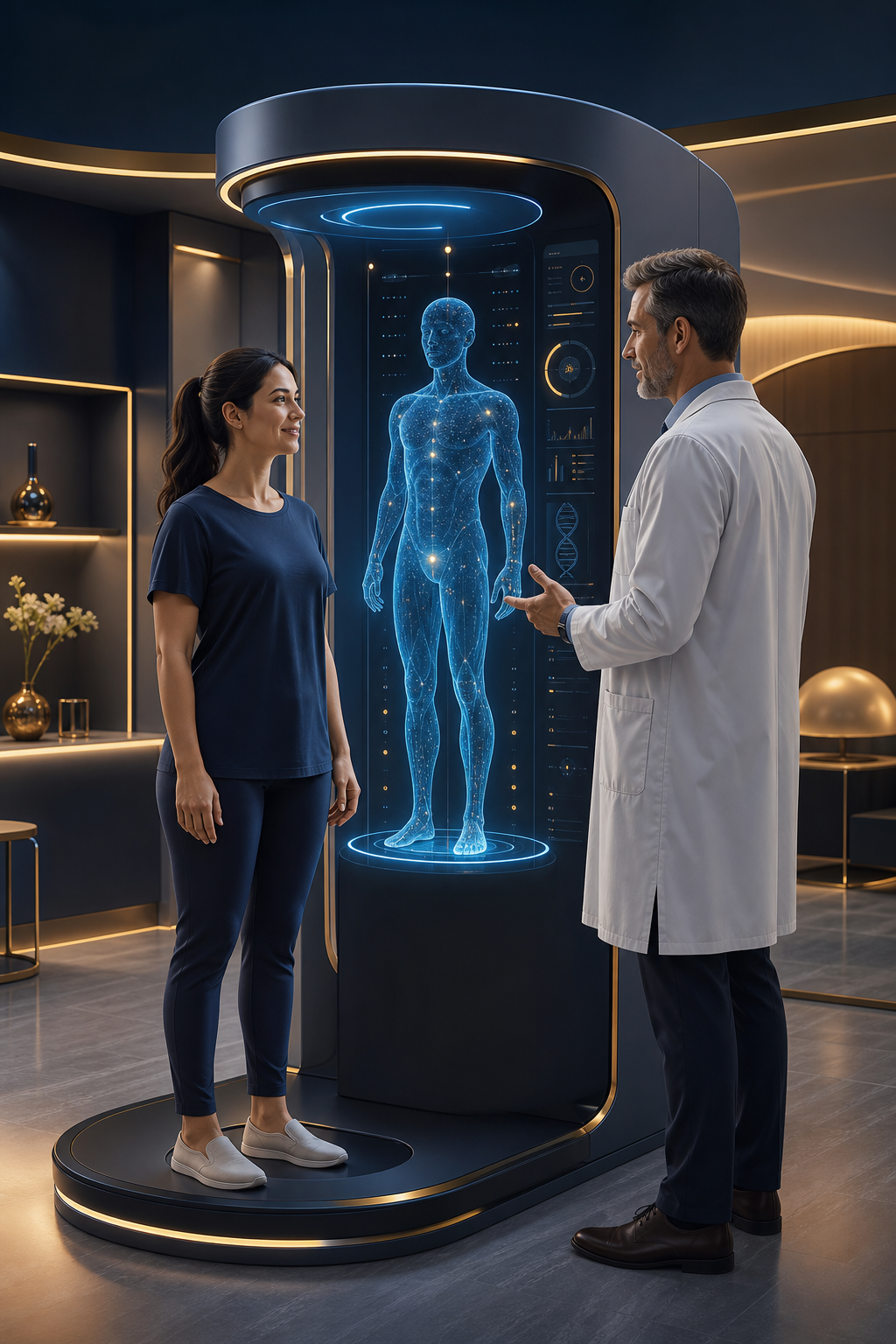
Midjourney Medical Full-Body Ultrasound Scanner: AI Imaging Company Enters Preventive Healthcare
Introduction
In June 2026, Midjourney—a company renowned for generative AI imagery—announced a strategic transformation that shocked the industry: the establishment of a "Midjourney Medical" division and the unveiling of a full-body ultrasound scanner prototype. This move marks a bold leap by an AI company from pure software into medical hardware, sparking widespread discussion in the medical community about AI technology's applications in preventive healthcare.
Technical Principles: Innovative Application of Underwater Ultrasound
How the Scanner Works
The Midjourney Scanner (officially called "Ultrasonic CT") employs a unique imaging approach that differs significantly from traditional medical imaging equipment:
Scanning Process:
- The user steps onto a platform that slowly descends into a shallow pool of water
- Thousands of underwater sensors surrounding the pool fire ultrasonic waves from multiple angles
- Ultrasound waves penetrate the body, and sensors receive reflected signals
- The system uses two petaflops of processing power to reconstruct cross-sectional images
- A complete 3D body composition map is generated in approximately 60 seconds
Imaging Content: The system can generate 3D maps of muscle, fat, bone, and organs, providing comprehensive body composition analysis.
Technical Partnership: Butterfly Network's Critical Role
The core hardware of the Midjourney Scanner comes from an exclusive licensing agreement with Butterfly Network (signed in November 2025). Butterfly Network provides its proprietary "Ultrasound-on-Chip" modules—a breakthrough technology that miniaturizes traditional ultrasound equipment.
Notably, despite Midjourney's prominence in generative AI, the company has clarified that the scanner currently does not use its generative AI models. The existing imaging technology is based on physics-based reconstruction rather than generative image synthesis. The company has expressed interest in potentially incorporating AI to improve services in the future.
Commercialization Roadmap
Midjourney Spa: Fusion of Health and Technology
Midjourney plans to open a "Midjourney Spa" at San Francisco's Union Square, expected to open by late 2027. This venue will combine high-tech medical scanning with traditional spa facilities:
- Full-body ultrasound scanning rooms
- Hot tubs
- Saunas
- Cold plunges
This "medical + wellness" hybrid model aims to lower the psychological barrier for users regarding medical scanning, integrating preventive health checkups into everyday healthy lifestyles.
Long-Term Expansion Goals
Midjourney has set ambitious global expansion plans:
- 2028: Launch third-generation scanner
- 2031: Deploy approximately 50,000 scanners globally
Regulatory Status: The FDA Certification Challenge
Current Positioning: Body Composition Mapping, Not Medical Diagnosis
The Midjourney Scanner is currently a first-generation prototype and has not received FDA clearance for diagnostic purposes. Therefore, the company plans to initially position the device as a "body composition mapping" tool rather than a medical diagnostic device.
The company states it will submit test results to the FDA over time to seek approval for broader diagnostic capabilities. This incremental regulatory strategy reflects the realistic complexity of the medical device market.
Medical Community's Cautious Stance
Medical professionals have expressed caution about the device's rollout, with primary concerns including:
Risk of Incidental Findings: Full-body scanning may discover abnormalities patients were previously unaware of. These "incidental findings" can lead to unnecessary follow-up examinations, patient anxiety, and even overtreatment.
Complementarity with Existing Modalities: Experts emphasize that the Midjourney Scanner cannot replace established examination methods like MRI, CT, or colonoscopies, as different scanning modalities serve distinct clinical purposes.
Necessity of Clinical Framework: Conducting full-body scans without an appropriate clinical framework may harm rather than help patients.
Market Context: Rapid Development of AI Medical Imaging
The emergence of Midjourney Medical reflects the rapid development of AI medical imaging in 2026.
Overall Industry Trends
In 2026, digital health funding reached $4 billion in Q1, and AI applications in healthcare have become so ubiquitous that analytics firm Rock Health removed it as a separate tracking category, calling it "table stakes" for the industry.
The FDA faces an unprecedented influx of generative AI-powered medical device applications and has expanded its regulatory framework to manage these dynamic tools that learn and adapt over time.
Public Trust Challenges
Despite rapid technological advancement, public trust in healthcare AI has declined in 2026. A national survey by Ohio State University's Wexner Medical Center showed that American trust in healthcare AI dropped from 52% in 2024 to 42% in April 2026. This trend reflects a shift from early enthusiasm toward a more cautious understanding.
Asia-Pacific Perspective: Enormous Potential for Preventive Healthcare
For the Asia-Pacific region, the concept of Midjourney Medical carries particularly important significance.
Market Demand for Preventive Healthcare
The Asia-Pacific region has the world's largest population base while facing the challenge of rapid aging. Countries like Japan, South Korea, and Singapore have among the world's fastest aging rates, creating urgent demand for preventive health management.
Full-body composition scanning as a non-invasive, rapid health assessment tool has enormous market potential among health-conscious consumers in the Asia-Pacific region.
Regulatory Environment Differences
Medical device regulatory frameworks vary across Asia-Pacific countries:
- Japan: PMDA (Pharmaceuticals and Medical Devices Agency) has a rigorous approval process for medical devices
- Singapore: HSA (Health Sciences Authority) adopts a risk-based regulatory approach
- China: NMPA (National Medical Products Administration) has dedicated approval channels for AI medical devices
- Hong Kong: Department of Health has relatively flexible medical device regulation
For Midjourney Medical to enter the Asia-Pacific market, it would need to develop differentiated market access strategies tailored to each country's regulatory requirements.
Health Tourism Opportunities
The Asia-Pacific region is an important destination for global health tourism, with countries like Thailand, Singapore, and South Korea attracting large numbers of international visitors seeking premium medical services. The Midjourney Spa concept—combining high-tech scanning with wellness experiences—aligns highly with the needs of the Asia-Pacific health tourism market.
Conclusion
Midjourney Medical's full-body ultrasound scanner represents a bold attempt by an AI company to cross into medical hardware. Despite current challenges including the absence of FDA certification and cautious attitudes from the medical community, its innovative technical approach and business model bring new possibilities to the preventive healthcare field.
For Asia-Pacific healthcare institutions, health technology investors, and policymakers, closely monitoring Midjourney Medical's development and thinking about how to introduce similar innovative technologies within local regulatory frameworks will be an important topic for the coming years.