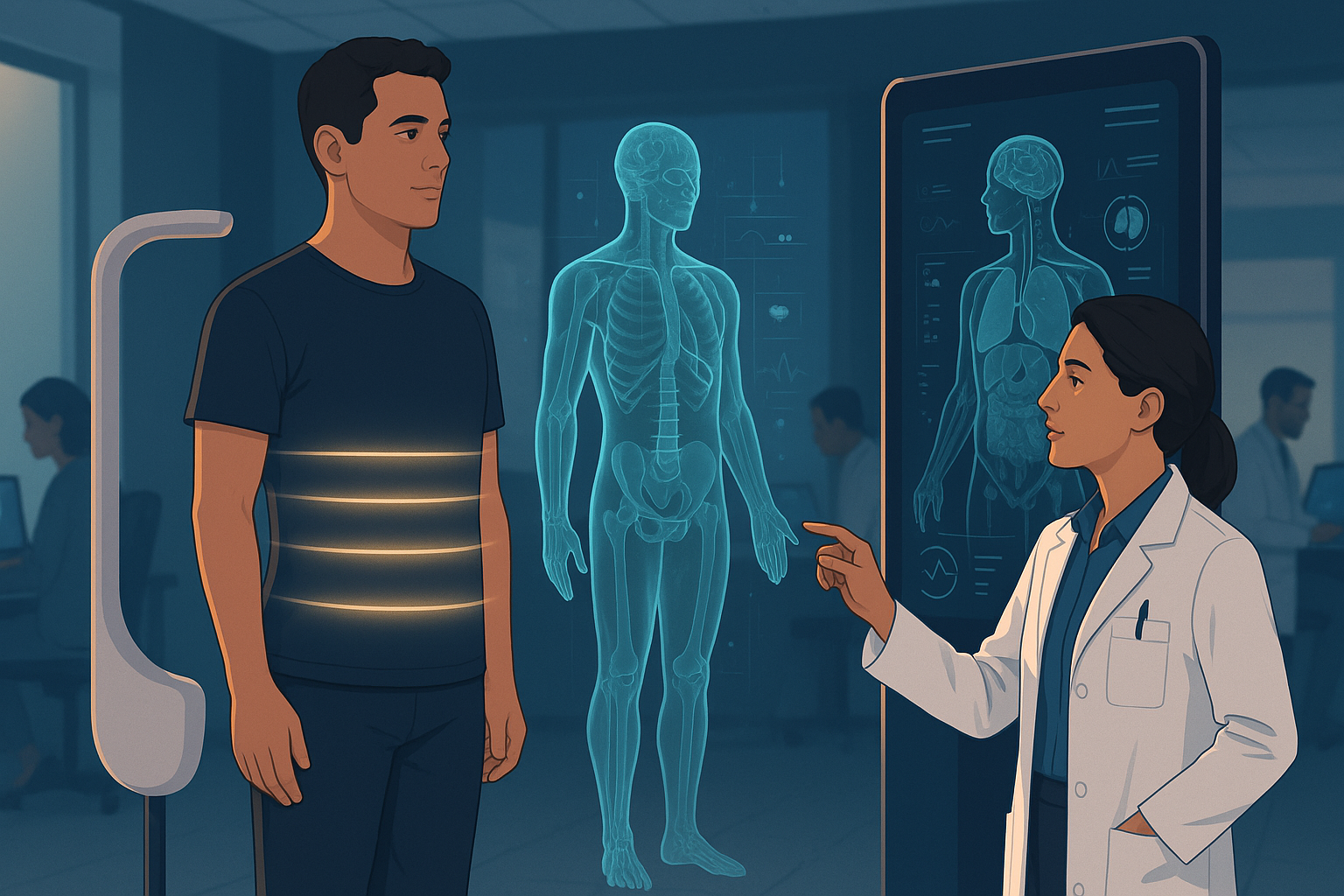
Midjourney Enters Healthcare: 60-Second Full-Body Ultrasound Scanner Generates 3D Body Maps, Exclusive Partnership with Butterfly Network
In June 2026, Midjourney — renowned for AI image generation — announced the formation of "Midjourney Medical" and unveiled a revolutionary full-body ultrasound scanner prototype. The device can generate 3D body maps in approximately 60 seconds, without ionizing radiation or magnetic fields, with plans to launch in a "spa" environment in San Francisco by late 2027.
Technical Principles: Ultrasonic Computational Tomography
Not Traditional Ultrasound
Midjourney Medical's scanner uses "Ultrasonic CT" (Ultrasonic Computational Tomography) technology, fundamentally different from traditional medical ultrasound devices. While conventional ultrasound emits sound waves from a single angle, Midjourney's system emits simultaneously from multiple angles, then computationally reconstructs complete 3D internal images.
The Scanning Process
Users descend via an elevator into a water-filled tub, with water serving as the acoustic transmission medium. A ring of sensors transmits ultrasonic waves through the body from multiple angles, and a compute cluster reconstructs these signals into 3D internal maps of bone, organs, fat, and muscle. The entire process takes approximately 60 seconds, requires no contrast injection, no ionizing radiation, and no strong magnetic fields.
Butterfly Network's Technical Foundation
Midjourney has established an exclusive licensing and co-development agreement with medical ultrasound company Butterfly Network. The prototype uses 40 Butterfly "Ultrasound-on-Chip" modules — semiconductor-based transducers — to capture imaging data. Butterfly Network's chip-level ultrasound technology makes it possible to achieve high-density sensor arrays in a relatively compact device.
Notably, Midjourney confirmed that its existing AI image generation models do not power the scanner's image formation — this is an entirely new technical direction, not an extension of existing AI capabilities.
Market Positioning: Consumer Health Tracking, Not Medical Diagnosis
"Spa" Experience Design
Midjourney plans to launch the service in San Francisco in a "spa" environment, featuring hot tubs, saunas, and other amenities to create a "casual" consumer health experience. This positioning deliberately avoids the regulatory framework for medical diagnosis, positioning the scanner as a health tracking tool.
Target Use Cases
Midjourney explicitly states that the device will initially be positioned as a "detailed body composition mapping" tool rather than a medical diagnostic device, helping users track longitudinal health trends:
- Muscle growth progress
- Visceral fat changes
- Sports injury recovery
- Overall body composition changes
Regulatory Pathway
As of June 2026, the device has not received FDA clearance for diagnostic use. Midjourney states plans to submit data to the FDA to gradually seek expanded capability clearance. The company's long-term goal is to deploy approximately 50,000 scanners worldwide by 2031.
Medical Community Response: Opportunities and Concerns
Radiologists' Warnings
The medical community has responded cautiously. Radiologists note that routine full-body scanning of asymptomatic individuals may lead to:
- Incidental findings: Discovering abnormalities unrelated to symptoms, triggering unnecessary follow-up examinations
- False positives: Misidentifying normal variations as pathological conditions, causing patient anxiety
- Over-medicalization: Drawing healthy individuals into the medical system, increasing unnecessary healthcare expenditure
Experts emphasize that ultrasound is not a universal replacement for MRI or CT scans, as different imaging technologies serve different diagnostic purposes.
Technical Limitations
Ultrasound imaging has limited penetration in certain tissues (such as lungs and deep bone structures), and image quality is affected by operator skill, patient body type, and other factors. While Midjourney's system improves image quality through multi-angle acquisition and computational reconstruction, it still faces these fundamental physical limitations.
Broader AI Medical Imaging Trends
Three Major Directions in AI Medical Imaging in 2026
Midjourney Medical's launch epitomizes broader trends in AI medical imaging in 2026:
1. Consumerization of Medical Imaging Traditionally, medical imaging equipment has been expensive, complex, and usable only in hospital settings. The combination of AI and new sensor technologies is driving the consumerization of imaging devices — from Oura ring heart rate monitoring to Midjourney's full-body ultrasound scanning.
2. AI-Assisted Radiology Report Drafting The FDA has granted "Breakthrough Device Designation" to multiple AI-assisted radiology report drafting tools. These tools analyze medical images to generate preliminary findings, allowing radiologists to focus on higher-value clinical judgment.
3. Multimodal AI Integration Healthcare AI in 2026 is shifting from single-modality (image-only or text-only) to multimodal integration — combining electronic health records, lab results, genomics, and medical imaging to provide a holistic view of patient health.
Preventive Healthcare Opportunities in Asia-Pacific
The preventive healthcare market in Asia-Pacific is growing rapidly. Consumers in Japan, Singapore, and South Korea show high acceptance of health tracking technology, and healthcare systems in these markets face chronic disease management pressure from aging populations. Midjourney Medical's consumer positioning may find a larger market in Asia-Pacific than in the United States — especially in Japan, where regular health checkups (人間ドック, ningen dock) are already an established consumer habit.
Investment and Commercial Prospects
Midjourney has invested over $74 million to launch the full-body ultrasound screening business. The company's business model has not been fully disclosed, but the "spa" positioning suggests a subscription or pay-per-use consumer service model.
The global deployment target of 50,000 units by 2031 means each device needs to serve enough users to cover costs. Analysts note that the company's main challenges include: clinical validation, regulatory approval, data privacy, and maintaining a clear boundary between consumer health tracking and medical diagnosis.
Conclusion
Midjourney Medical's full-body ultrasound scanner represents a new model for AI companies entering healthcare: rather than directly entering the strictly regulated medical diagnosis market, it enters through consumer health tracking, gradually accumulating clinical data and regulatory trust. The success of this path will depend on continuous technological improvement, the evolution of regulatory frameworks, and consumer acceptance of "spa-style health scanning."