
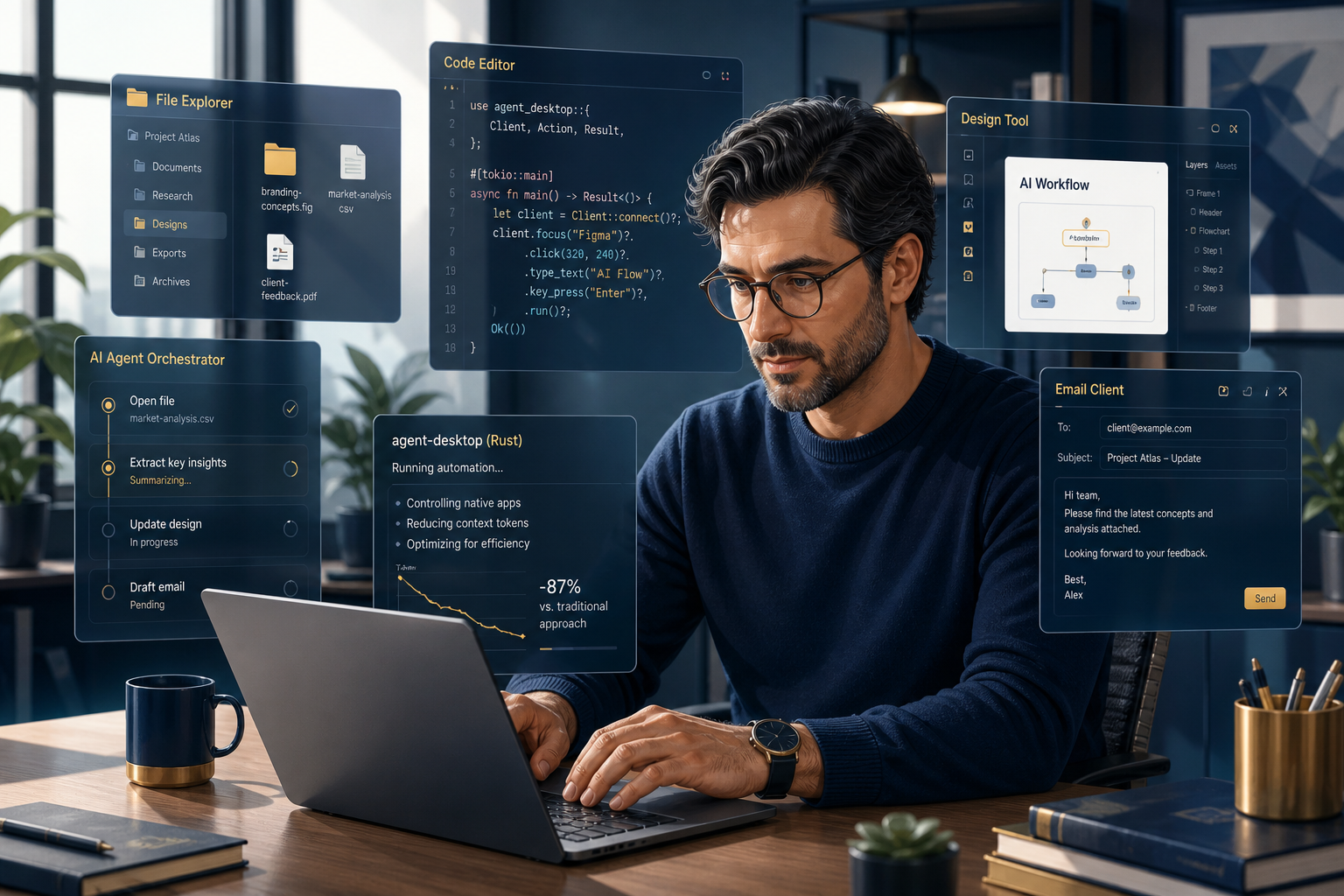
Vercel Labs Releases agent-desktop: Rust Open-Source Tool Enables AI Agents to Control Native Desktop Apps, Reducing Token Usage by 78-96%
On October 30, 2026, Vercel Labs officially released agent-desktop v1.0.2, an open-source Rust CLI tool and C library that enables AI agents to interact with desktop applications through the operating system's native accessibility tree, rather than relying on screenshots and pixel coordinates.
This tool's release marks an important technical evolution in AI agents' "computer use" capabilities — shifting from visual recognition to structured, deterministic interface interaction.
Core Technology: Accessibility Tree vs. Screenshot Approach
Traditional AI computer use tools (like early Claude Computer Use) rely on screenshots and visual recognition:
- Capture a screenshot
- Use a visual model to identify UI element positions
- Execute click/input operations based on pixel coordinates
This approach has significant drawbacks:
- Pixel coordinates become invalid when windows are resized
- Visual recognition consumes large amounts of tokens
- Non-deterministic — the same operation may produce different results
agent-desktop's Solution:
Directly reads UI structure through the OS's native accessibility APIs:
- macOS: AX API (Accessibility API)
- Windows: UI Automation
- Linux: AT-SPI (Assistive Technology Service Provider Interface)
Each UI element is assigned a unique "ref" identifier (e.g., @s8f3k2p9:e8), and agents execute operations via refs rather than pixel coordinates.
Performance Data: Token Savings
agent-desktop's "skeleton" and "drill-down" features are designed to minimize LLM token consumption:
| Application | Token Savings |
|---|---|
| Slack | 78-96% |
| VS Code | 78-96% |
| Notion | 78-96% |
How it works:
- Skeleton snapshot: Maps only top-level nodes to get the application's overall structure
- Drill-down: Dives into specific regions of interest for detailed information
- On-demand loading: Only sends the UI data the agent actually needs to the LLM
Compared to full-window screenshots or complete tree dumps, this approach dramatically reduces token consumption per operation, directly lowering API call costs.
Deterministic Interaction: The STALE_REF Mechanism
A key design feature of agent-desktop is deterministic interaction:
- Operations are based on accessibility identifiers rather than pixel coordinates
- Actions remain consistent even when windows are resized or UI elements move
- If the UI changes, the tool returns
STALE_REForAMBIGUOUS_TARGET, prompting the agent to refresh its snapshot
This mechanism ensures the reliability of agent operations, avoiding the "clicking the wrong place" problem common with visual methods.
Headless Execution and Parallel Support
Headless Mode (Default):
- Commands execute silently in the background
- The mouse cursor doesn't move, and windows don't gain focus
- Users can continue working normally while the agent operates in the background
Multi-Agent Parallel Support:
- Supports session-specific cursor overlays
- Multiple agents can simultaneously control different applications
- Suitable for complex multi-agent workflows
Technical Specifications
Platform Support:
- macOS 13+
- Windows 10 1809+ / Server 2019+
- Linux (Ubuntu 24.04+, requires at-spi2-core)
Installation:
npm install -g agent-desktop
(Automatically bundles native binaries for x64 and ARM64 architectures)
Language Bindings:
In addition to the CLI, libagent_desktop_ffi is provided for in-process library calls from Python, Swift, Go, Ruby, Node, and other languages.
Security Considerations
Due to the tool's deep OS access, Vercel Labs emphasizes strict security measures:
- Data Sensitivity: Snapshots, clipboard contents, and screenshots may contain private desktop data; avoid storing in public logs or cloud uploads
- Access Control: Requires standard OS accessibility permissions
- Isolation Recommendation: For sensitive tasks, run agents under isolated users or virtual machines
Impact on the AI Agent Ecosystem
The release of agent-desktop has significant implications for the entire AI agent ecosystem:
Lowering the Computer Use Barrier: Open-source MIT license means any developer can use and modify it for free
Improving Reliability: Deterministic interaction replaces visual recognition, dramatically reducing operation failure rates
Reducing Costs: 78-96% token savings directly translate to lower API call costs
Expanding Use Cases: Supports all native desktop applications, not limited to web interfaces
Asia-Pacific Perspective
For enterprises and developers across the Asia-Pacific region, agent-desktop opens up multiple new automation possibilities:
Enterprise Process Automation: Many Asia-Pacific enterprises still use extensive desktop software (ERP, CRM, financial systems). agent-desktop enables AI agents to directly control these systems without waiting for vendors to provide APIs.
Localized Software Support: Through the accessibility tree approach, agents can control any application that supports OS accessibility APIs, including localized software with Japanese, Korean, and Chinese interfaces.
Cost Efficiency: The 78-96% token savings are particularly important for large-scale deployments, significantly reducing the operational costs of enterprise AI automation.
Conclusion
Vercel Labs' agent-desktop represents an important technical leap in AI agents' computer use capabilities. By shifting from visual recognition to structured accessibility tree interaction, it addresses the core pain points of traditional approaches: non-determinism, high token consumption, and dependence on pixel coordinates. The 78-96% token savings and deterministic operations make it a powerful tool for enterprise-grade AI automation.