
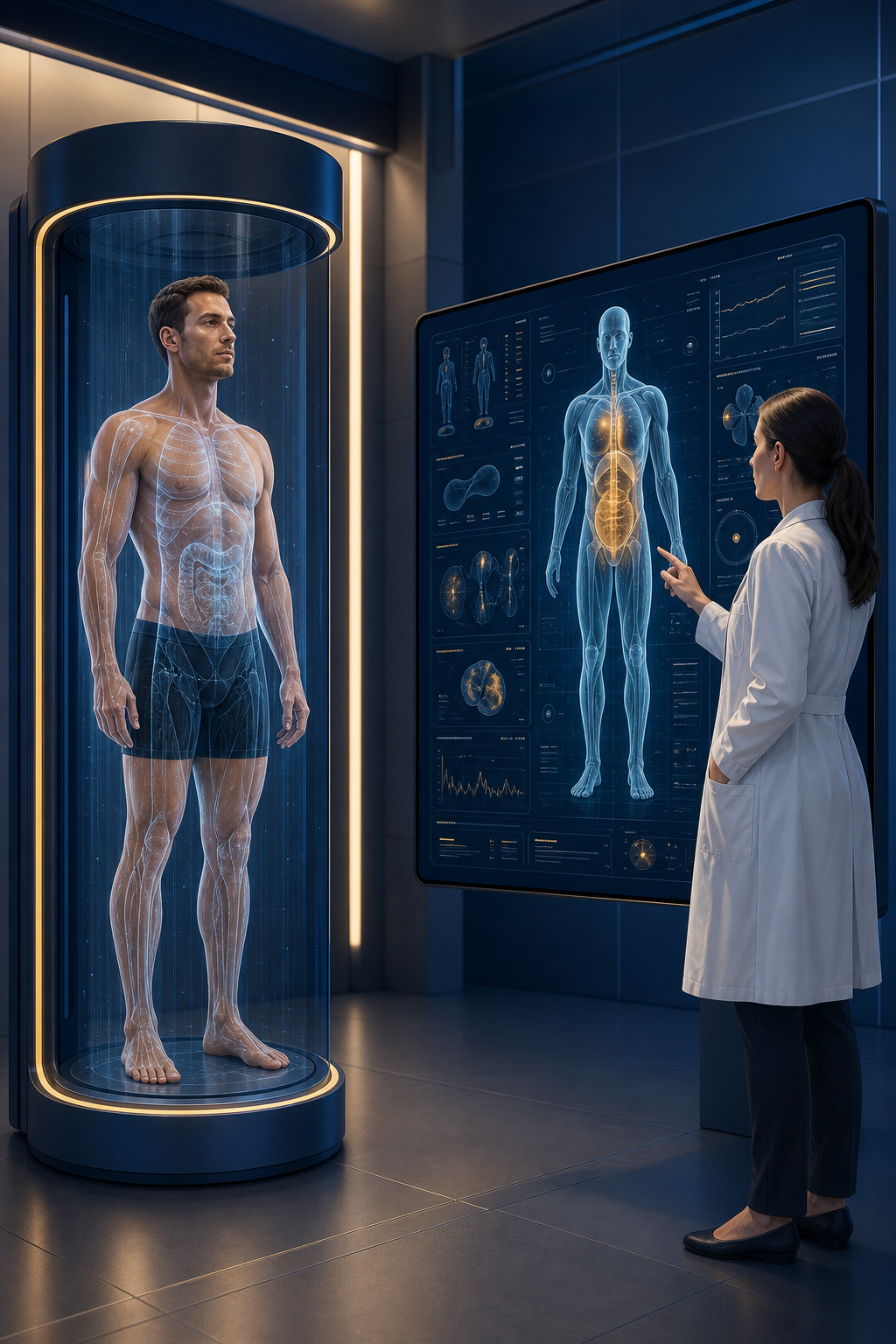
Midjourney Medical Launches Full-Body Ultrasound Scanner: 60-Second 3D Body Maps, Targeting 50,000 Deployments by 2031, Pending FDA Clearance
Midjourney, known for its AI image generation, announced the formation of a healthcare division "Midjourney Medical" in June 2026, unveiling a revolutionary full-body ultrasound scanner prototype. The device can generate 3D cross-sectional images of human organs, muscle, fat, and bone in approximately 60 seconds, attracting widespread attention from the medical and technology communities. However, the device remains a first-generation prototype and has not yet received FDA clearance for diagnostic use.
Technical Principles: "Ultrasonic CT"
Midjourney calls its technology "Ultrasonic CT," but unlike traditional CT scans, this technology does not use X-rays or ionizing radiation, making it safer for the human body.
The scanning process works as follows: a user is lowered into a shallow pool of water where a ring of ultrasonic sensors captures data from multiple angles. A compute cluster then reconstructs these sound waves into 3D cross-sectional images, with the entire process taking approximately 60 seconds.
The technical core is "Ultrasound-on-Chip" technology licensed from Butterfly Network under a $74 million, five-year agreement. Notably, the scanner does not currently use Midjourney's generative AI models — the imaging process relies on hardware and signal processing rather than AI-generated imagery.
Positioning: Body Composition Mapping, Not Medical Diagnosis
Since FDA approval has not yet been obtained, Midjourney Medical's initial service is positioned as "detailed body composition mapping" rather than medical diagnosis. Body composition mapping does not require FDA approval and can be legally offered to consumers.
Specifically, the scanner can provide:
- 3D visualization of organ location and size
- Distribution maps of muscle, fat, and bone
- Body composition ratio analysis
- Time-series tracking of body structure
This information appeals to fitness enthusiasts, athletes, and health-conscious consumers, but medical professionals warn that full-body imaging outside a clinical context can lead to incidental findings, false positives, and patient anxiety without professional interpretation.
Ambitious Business Plans
Midjourney has outlined extremely ambitious business plans for its medical division:
Midjourney Spa: Plans to build a 25,000-square-foot flagship facility in San Francisco, expected to open in late 2027. This facility will integrate scanning technology with wellness amenities such as saunas, hot tubs, and cold plunges, creating a "health tech spa" experience.
Global Deployment Target: The company plans to deploy 50,000 scanners globally by 2031, with a long-term capacity target of one billion scans per month.
Hardware Evolution: A second-generation scanner using custom silicon is targeted for development by 2028.
FDA Approval Pathway
Midjourney states it will incrementally pursue FDA clearance to expand diagnostic capabilities. This process typically takes several years, including clinical trials, safety assessments, and regulatory review.
There are typically two FDA approval pathways for medical devices:
- 510(k) Clearance: For devices substantially equivalent to already-approved devices, typically taking 3-12 months
- PMA (Premarket Approval): For high-risk devices, typically taking 3-7 years
As a novel device, the full-body ultrasound scanner may need to follow the PMA pathway, meaning Midjourney Medical could face several years before obtaining full diagnostic approval.
Medical Community's Cautious Stance
Medical professionals are cautious about Midjourney Medical's entry. Key concerns include:
Incidental Findings: Full-body imaging may discover abnormalities unrelated to the patient's chief complaint. These "incidental findings" require further investigation, potentially leading to unnecessary medical interventions and patient anxiety.
False Positive Risk: Interpreting ultrasound imaging requires professional training, and automated systems may generate false positive results that mislead consumers.
Lack of Clinical Context: Without medical professional oversight, consumers may not correctly understand the clinical significance of scan results.
Asia-Pacific Market Opportunities
The Asia-Pacific region is one of the fastest-growing markets for healthcare AI globally. Consumers in Japan, South Korea, Singapore, and Australia have relatively high acceptance of preventive health technology, providing potential markets for Midjourney Medical's global expansion.
However, medical device regulatory frameworks vary across Asia-Pacific countries. Japan's PMDA, South Korea's MFDS, Singapore's HSA, and Australia's TGA all have their own approval requirements, and Midjourney Medical will need to address these regulatory challenges one by one when entering the APAC market.
Broader AI Medical Imaging Trends
Midjourney Medical's entry reflects the broader trend of AI companies expanding into healthcare. In 2026, the European Society of Cardiology (ESC) Congress featured a deep-learning model capable of detecting early markers for hypertension, stroke, and ischemic heart disease from standard breast cancer mammograms.
Simultaneously, Eli Lilly and Insilico Medicine reached a collaboration valued at up to $2.75 billion for AI drug discovery, Sanofi partnered with Owkin to develop agentic AI systems for R&D, and Roche deployed over 3,500 NVIDIA Blackwell GPUs to accelerate diagnostics and manufacturing.
These developments collectively paint a picture of AI deeply reshaping the healthcare industry.
Conclusion
Midjourney Medical's full-body ultrasound scanner represents a bold attempt by an AI company to enter the healthcare space. The technical capability of 60-second 3D body maps is impressive, but its application scope remains limited until FDA diagnostic clearance is obtained. For healthcare investors and policymakers in the Asia-Pacific region, this development is worth watching — it may signal further blurring of the boundary between consumer health technology and medical diagnostics.