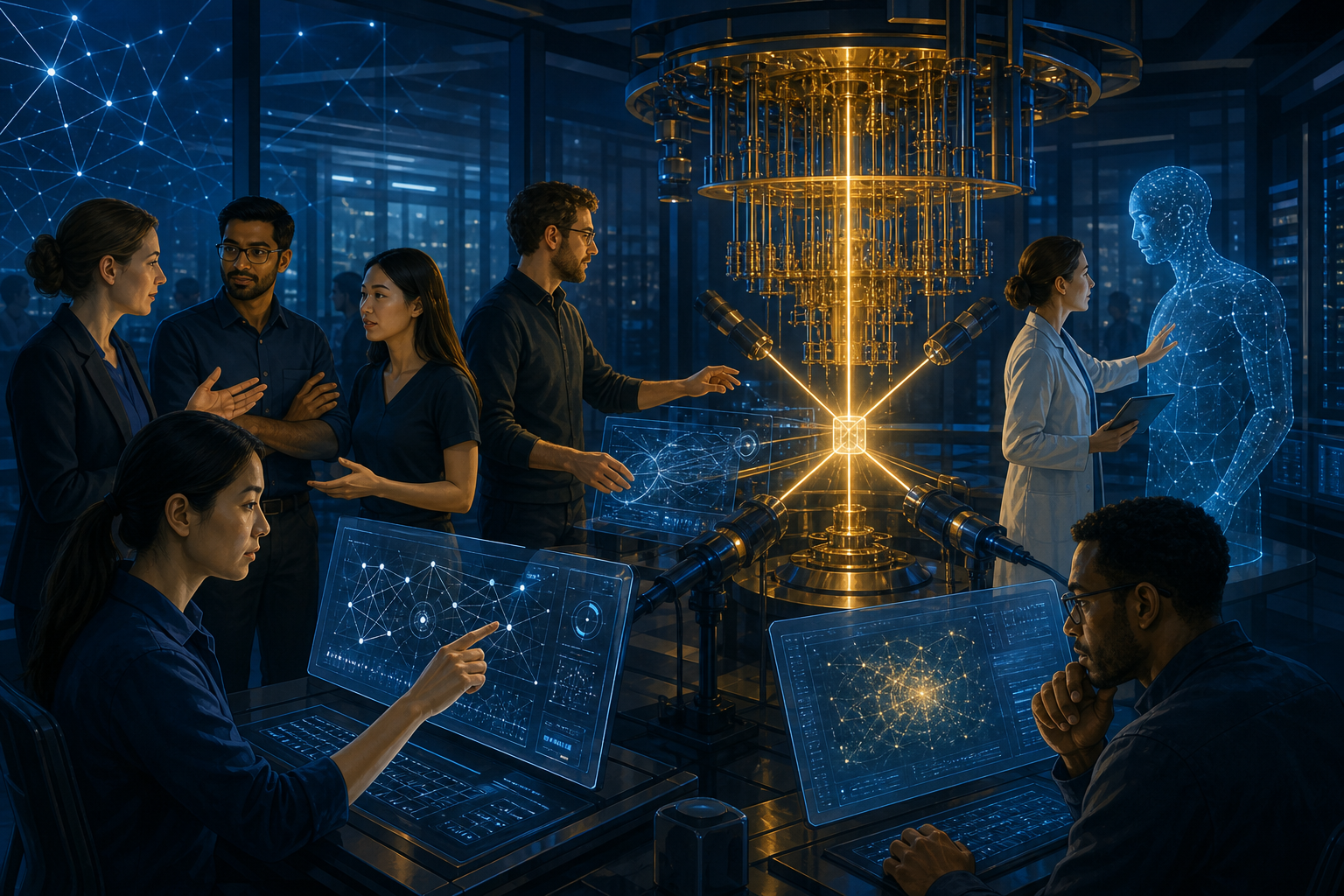
Anthropic Model Hardware Standard (MHS) Research Preview: AI Agents Directly Control Physical Equipment, QuEra Quantum Laser Success Rate Jumps from 58% to 99.3%
Introduction
On August 27, 2026, Anthropic officially announced the Model Hardware Standard (MHS) research preview — a revolutionary technical framework designed to enable AI agents to directly discover, monitor, and operate physical laboratory equipment and manufacturing machinery. From robotic arms and liquid handlers to quantum computer laser systems, MHS opens the door to the physical world for AI agents, marking a significant leap from purely digital domains to physical-digital integration.
Background: The Historical Challenge of Hardware Integration
Before MHS, AI agent integration with physical equipment faced fundamental challenges. Devices from different manufacturers — robotic arms, microscopes, liquid handlers — often lacked unified communication interfaces, requiring custom "translator" programs for each device combination. This meant:
- Long integration cycles: Ranging from weeks to months
- High costs: New development required for each new device combination
- Poor scalability: Inability to quickly adapt to new devices or experimental requirements
- Limited AI capabilities: Even the most advanced AI models couldn't directly interact with physical devices
MHS's core mission is precisely to solve this pain point: through a standardized driver layer, enabling AI agents to complete integration with new devices in hours (rather than weeks).
MHS Technical Architecture
Core Design Principles
MHS functions as a "translation" layer between the operating system and physical hardware, employing these core designs:
Simple Primitives: All devices communicate through standardized "read" and "write" commands, significantly reducing the complexity for AI agents to understand and control equipment.
Discovery Mechanism: MHS maintains a shared state dictionary and uses natural language tags to describe device characteristics. This enables AI agents to understand devices they've never encountered — for example, tags can encode a robotic arm's weight limits, range of motion, and safety boundaries, allowing AI trained primarily in virtual environments to "reason" about physical hardware.
Safety Layer: Before executing any command, MHS enforces device-level safety limits (such as laser power caps), ensuring AI agent operations don't exceed equipment safety boundaries.
Model Agnostic: MHS is designed to be model-agnostic, usable with various AI agents, typically combined with the Model Context Protocol (MCP) for richer interactions.
Synergy with MCP
MHS complements Anthropic's previously launched Model Context Protocol (MCP): MCP addresses AI agents accessing digital information and tools, while MHS addresses AI agents controlling physical devices. Together, they provide AI agents with complete "digital + physical" operational capabilities.
Real-World Cases: Impressive Experimental Results
MHS's research preview has achieved remarkable results at multiple leading institutions:
QuEra Computing: Quantum Laser Stability Breakthrough
QuEra Computing is a leading quantum computing company whose quantum computers rely on precise laser systems to maintain qubit coherence. Laser "lock" recovery is a critical and time-consuming operation.
Using MHS, the AI agent improved laser lock recovery success rates from 58% to 99.3%, while significantly reducing recovery time. This result has important implications for quantum computing's practical applications — higher laser stability directly translates to longer quantum computing run times and more reliable computational results.
Genentech: Protein Assay Automation
Genentech scientists used MHS to automate the BCA protein assay process, coordinating three devices — a liquid handler, robotic arm, and plate reader — to work in concert. The system successfully recovered from physical errors (such as tip pickup failures) without human intervention.
Notably, researchers pointed out that Claude still requires human oversight to distinguish between software errors and physical failures (such as sample foaming), indicating that MHS in its current phase is better suited as a human-AI collaboration tool rather than a fully autonomous system.
Carnegie Mellon University: Dose-Response Experiment Acceleration
CMU researchers used MHS to coordinate multiple computers for dose-response experiments, achieving experiment speeds three times faster than previous manual processes. More importantly, integrating a liquid handler, plate reader, and robotic arm took only approximately eight hours — far less than the weeks required by traditional vendor-customized solutions.
Tetsuwan Scientific: Environmental Monitoring Application
Tetsuwan Scientific used MHS for environmental research, detecting human-specific fecal contamination in water samples through automated qPCR workflows, demonstrating MHS's application potential in environmental science.
Partner Ecosystem
Anthropic co-developed MHS with the HHMI Janelia Research Campus and has established an extensive partner network:
Hardware Manufacturers: Universal Robots, Doosan Robotics, Automata, Danaher, MBF Bioscience, QIAGEN, Tecan, Raspberry Pi
Technology Platforms: Amazon Web Services (via Strands Robots library), Hugging Face (LeRobot)
Research Institutions: Carnegie Mellon University, QuEra Computing, Genentech, Tetsuwan Scientific
The breadth of this ecosystem suggests MHS has the potential to become an industry standard, similar to USB's role in consumer electronics.
Current Limitations and Future Outlook
Anthropic maintains transparency about MHS's current limitations:
Technical Limitations:
- Devices must have programmable interfaces (API, SDK, or GUI) to be compatible with MHS
- Current AI models still face challenges with physical and chemical reasoning, particularly identifying subtle physical failures
- All published results during the research preview phase used Claude; other models' performance remains to be verified
Open Source Plans: Anthropic plans to open-source the MHS specification but has not committed to a specific release date. Before open-sourcing, the company will use the research preview phase to develop robust safety evaluations and best practices.
Access Restrictions: Currently only open to select partners, including the institutions and companies mentioned above.
Strategic Significance for Asia-Pacific
MHS has special significance for Asia-Pacific research and manufacturing:
Japanese Manufacturing: Japan is one of the world's largest industrial robot markets. MHS could significantly reduce the cost and complexity of integrating AI with industrial robots, accelerating the realization of "smart factories."
Singapore Biopharmaceuticals: Singapore is an important Asia-Pacific biopharmaceutical R&D center. MHS has broad application prospects in laboratory automation scenarios such as protein assays and drug screening.
Chinese Research Institutions: China's investment in quantum computing and life sciences continues to increase. MHS's open-source plans will provide important technical resources for Chinese research institutions.
Korean Semiconductors: Korea's semiconductor manufacturing industry has extremely high requirements for precision equipment control. MHS's standardized interface could find important applications in semiconductor manufacturing automation.
Conclusion
Anthropic's Model Hardware Standard represents an important turning point in AI development: AI agents are no longer limited to the digital world but are beginning to truly enter the physical world. Real data — QuEra's quantum laser success rate leap from 58% to 99.3%, CMU's three-fold experiment speed improvement — fully demonstrates MHS's practical value.
As MHS moves toward open source and expands its partner ecosystem, we have good reason to expect AI agents to play increasingly important roles in scientific research, manufacturing, and healthcare. For Asia-Pacific enterprises and research institutions, closely monitoring MHS's development and planning integration strategies in advance will be key to riding this technological wave.