
Fei-Fei Li's World Labs Releases Atlas World Model: Multimodal Spatial Intelligence Generates 1440p Video and 3D Reconstruction, Ushering in New Era for Robotics Training
Introduction
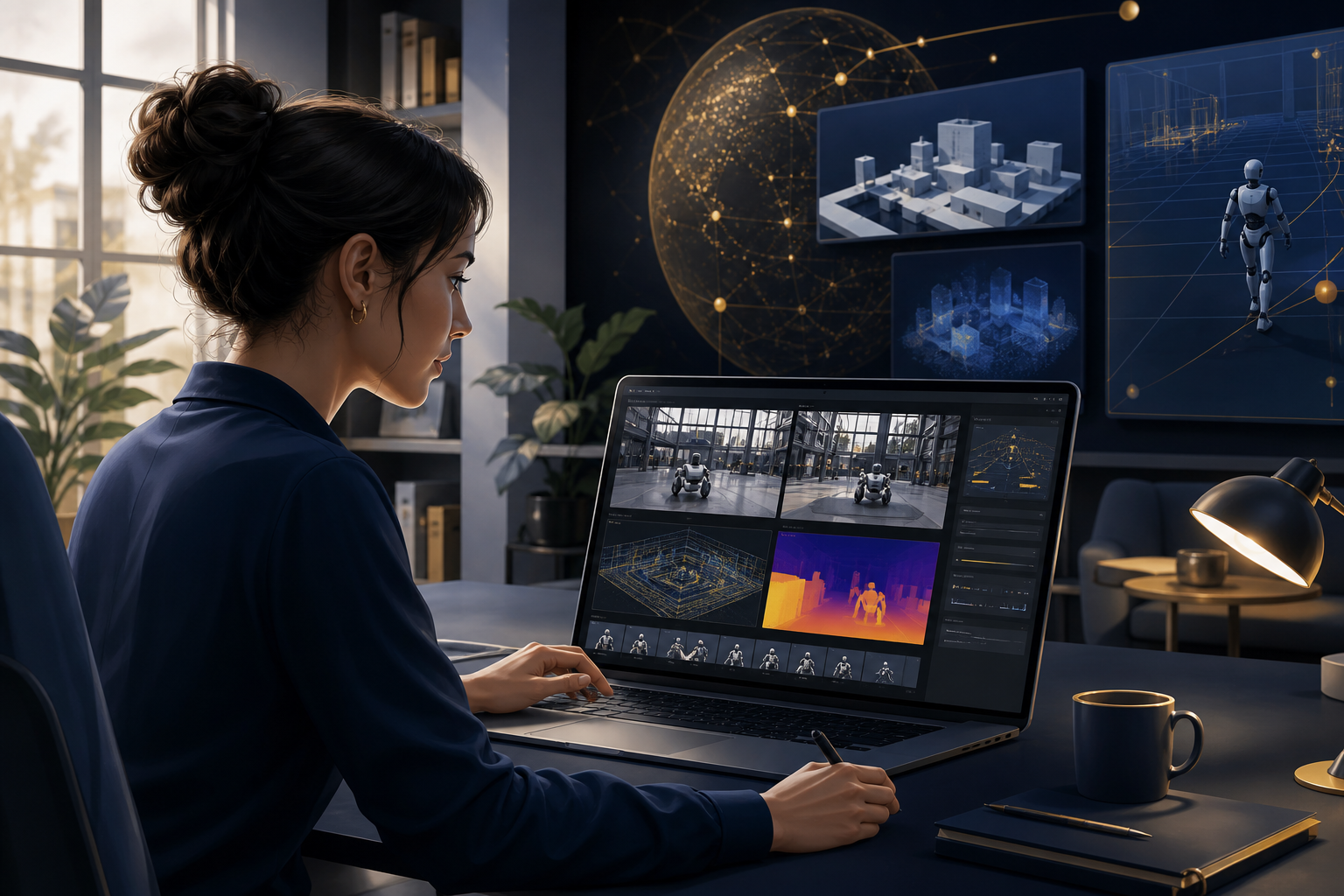
On September 1, 2026, World Labs — co-founded by AI pioneer Fei-Fei Li — officially released Atlas, an "omni" world model designed for spatial intelligence. Atlas employs a multimodal autoregressive diffusion transformer architecture, natively processing text, images, video, and 3D data within a unified spatial framework, generating up to one minute of 1440p high-definition video and enabling precise 3D scene reconstruction.
Atlas's Core Capabilities
Camera-Controlled Generation
One of Atlas's most impressive capabilities is precise camera-controlled generation. Starting from reference images, users can define specific camera trajectories, and the system generates scene videos that remain consistent in 3D space, at resolutions up to 1440p and durations up to one minute.
This capability has revolutionary implications for filmmaking, game development, and virtual reality content creation — creators can generate high-quality video content from any angle without expensive camera equipment.
Spatial Reconstruction
Atlas can reconstruct real-world scenes from a variable number of input images, ranging from a single frame to dozens. Compared to specialized open-source 3D reconstruction models, Atlas fills in gaps with its internal world knowledge, outputting explicit 3D representations including point clouds and 3D Gaussian splats.
Space-Time Simulation
Atlas models both spatial structure and temporal evolution, supporting:
- "Bullet time" style video reframing: Generating multi-angle slow-motion effects from simple camera setups
- Real-to-Sim workflows: Generating photorealistic RGB and depth data for training and testing robots in diverse virtual environments
Image Generation
Beyond world modeling, Atlas also features powerful image generation capabilities, supporting text-to-image and 360-degree panorama generation with complex prompt adherence and text rendering.
Technical Architecture: Multimodal Autoregressive Diffusion Transformer
Atlas employs a multimodal autoregressive diffusion transformer architecture that treats inputs as sequences grounded in a 3D spatial context, allowing the model to generate outputs conditioned on that context.
By combining the autoregressive nature of large language models (LLMs) with the latent diffusion techniques used in modern video generation, Atlas benefits from architectural and systems advancements in both fields, including diffusion distillation and classifier-free guidance.
World Labs' Development Journey
Company Background
World Labs was co-founded by AI research pioneer Fei-Fei Li, renowned for her groundbreaking work on ImageNet and computer vision. The company's mission is to develop AI systems that can understand and generate the physical world.
Funding History
- Total funding: $1.23 billion
- February 2026: Completed $1 billion funding round with investors including Autodesk, AMD, NVIDIA, and Fidelity
- July 2026: Acquired SceniX to bolster robotics-related spatial intelligence capabilities
Product Evolution
- November 2025: Released first commercial multimodal model, Marble
- January 2026: Launched World API
- September 2026: Released Atlas world model
Impact on Robotics and Automation Industries
Real-to-Sim Breakthrough
Atlas's Real-to-Sim workflow has profound implications for robotics training. Traditionally, robots require extensive trial-and-error training in real environments, which is costly and time-consuming. Atlas can generate realistic virtual training environments from real-world scene images, dramatically reducing the cost and time of robot training.
Asia-Pacific Application Prospects
Asia-Pacific leads globally in manufacturing automation and robotics applications. Atlas's capabilities are particularly significant for:
- Japanese and Korean manufacturing robots: Using Real-to-Sim to accelerate factory automation
- Chinese logistics robots: Training warehouse and delivery robots in virtual environments
- Singapore's smart city projects: Generating 3D models of urban environments for planning and simulation
Access and Commercialization
Atlas is not open-source; it is a proprietary, cloud-accessible model. World Labs began accepting early access requests upon its announcement, with plans to integrate Atlas into future versions of its commercial products such as Marble.
Competitive Landscape
Atlas's release comes amid intensifying competition in spatial AI and world modeling. Google DeepMind, Meta, and multiple startups are actively developing similar capabilities. World Labs' differentiation advantages include:
- Fei-Fei Li's deep academic background in computer vision
- Focused positioning on spatial intelligence
- Strong robotics training application scenarios
Conclusion
The release of Atlas marks an important milestone in world model technology. By unifying text, images, video, and 3D data within a spatial framework, Atlas provides powerful new tools for robotics training, film production, game development, and virtual reality. As spatial AI technology continues to advance, we are entering a new era where AI can truly understand and generate the physical world.
Sources: World Labs Official Blog, Crypto Briefing, KuCoin (September 2026)